Every peptide, explained from the beginning.
Peptide Lexicon is a reference library of individual peptides, written for readers with no background in the subject. Each entry states what the compound is, what it is commonly said to be good for, what the published research actually shows, and where the compound stands with regulators. Entries report what studies, labels and regulators say, and attribute and date every claim; they never instruct a reader to use anything. The library does not rank vendors, does not publish best-of roundups, and does not sell anything.

Written for the first time you read it
Every term is explained where it appears. No assumed background, no jargon left standing.
Rats and people are never the same sentence
Each entry says plainly how much of the evidence is human, and how much is not.
Every compound, kept current
The library is checked weekly against the full compound roster, and every entry carries the date it was last reviewed.
Latest
All 169 compounds →
Pegcetacoplan (Empaveli, Syfovre): Two 15-Residue Peptides on a PEG Chain That Block Complement C3 — What It Is and What Its Labels Show
Pegcetacoplan is two identical 15-residue peptides joined to the ends of a 40 kDa polyethylene glycol chain. It blocks complement protein C3 and is sold under two names: Empaveli, injected under the skin for PNH and two kidney diseases, and Syfovre, injected into the eye for geographic atrophy. Its structure, its trials, its warnings.
Updated 2026-10-22

Palopegteriparatide (Yorvipath): Teriparatide on a Slow-Release Carrier for Hypoparathyroidism — What It Is and What Its Label Shows
Palopegteriparatide, sold as Yorvipath, is the 34-amino-acid front end of parathyroid hormone attached to a 40 kDa polyethylene glycol carrier through a linker that releases it slowly. It is approved for adults with hypoparathyroidism. Its chemistry, its one placebo-controlled trial and the label's warnings.
Updated 2026-10-22

MK-677 (Ibutamoren): Not a Peptide but a Pill That Mimics Ghrelin — What It Is and What Its Human Trials Show
MK-677, or ibutamoren, is not a peptide: it is a small molecule of 528.7 Da that Merck developed in the 1990s to copy ghrelin's action on the growth-hormone secretagogue receptor, taken by mouth. It was never approved. What it is, what its trials in older adults and hip-fracture patients found, and why one was stopped early.
Updated 2026-10-22

CagriSema: Cagrilintide Plus Semaglutide in One Weekly Injection — What It Is and What the REDEFINE Trials Show
CagriSema is not one molecule but two peptides given together once a week: cagrilintide, a long-acting amylin analogue, and semaglutide, the GLP-1 drug in Wegovy and Ozempic, at 2.4 mg each. It is not approved. What each part is, what the two phase 3 REDEFINE trials found, and what they did not test.
Updated 2026-10-22

Bleomycin: A Glycopeptide Antibiotic Used as Cancer Chemotherapy — What It Is, How It Breaks DNA and What Its Label Warns
Bleomycin is a mixture of glycopeptide antibiotics made by the soil bacterium Streptomyces verticillus, used since 1973 as cancer chemotherapy for testicular cancer, lymphomas and squamous-cell cancers. It is dosed in units, not milligrams. What it is, how it damages DNA, and the lung toxicity that defines its label.
Updated 2026-10-22

Epitalon: The Telomere Peptide, and Who Did the Research
Epitalon is a four-amino-acid peptide from pineal extract, claimed to lengthen telomeres. The claims are real published findings — the question is who published them.
Updated 2026-10-21

Are Peptides Good for You, or Safe? The Library Counted
Peptides are a chemical class, not a product. Of this library's 107 compound entries, 30 are approved medicines; the research-market best sellers have almost no human record.
Updated 2026-10-21

Somatropin (Human Growth Hormone, HGH): The 191-Amino-Acid Pituitary Protein and Its Recombinant Copies
Somatropin is recombinant human growth hormone: a 191-amino-acid protein with the same sequence as the hormone the pituitary makes. It is approved for children with growth failure and adults with growth hormone deficiency, and US law restricts its distribution to approved uses. Its structure, the pituitary-extract era it replaced, the long-acting versions and where it stands.
Updated 2026-10-20
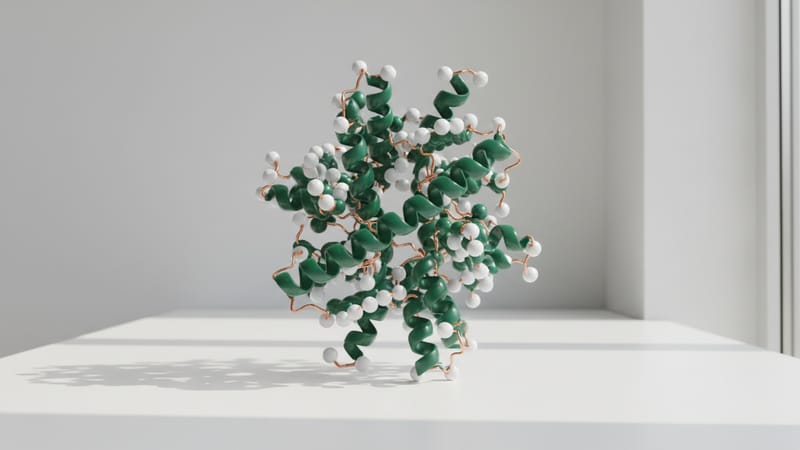
Prolactin: The 199-Amino-Acid Pituitary Hormone Behind Milk Production — a Protein, Not a Short Peptide
Prolactin is a 199-amino-acid hormone of the anterior pituitary, best known for driving milk production. It is held in check mainly by dopamine from the brain, and its blood test can mislead when much of it circulates as 'macroprolactin'. What it is, what raises it, and what is and is not established.
Updated 2026-10-20

Lactoferrin: The Iron-Binding Milk Protein — and Lactoferricin, the Peptide Cut From It
Lactoferrin is an iron-binding glycoprotein of about 690 amino acids found in breast milk, colostrum and mucosal secretions — a protein, not a peptide. When stomach pepsin cuts it, it releases lactoferricin, a short antimicrobial peptide. What both are, what lactoferrin is sold for, and what the large infant trials found.
Updated 2026-10-20

GLP-1 (Glucagon-Like Peptide-1): The 30-Amino-Acid Gut Hormone, Its Gene and Its Rapid Breakdown
GLP-1 is the body's own 30- or 31-amino-acid hormone, cut from the proglucagon precursor in gut L-cells after a meal. It raises insulin, lowers glucagon and slows the stomach — and is broken down by the enzyme DPP-4 almost as soon as it is released. The hormone, its discovery and why the medicines are different molecules.
Updated 2026-10-20
Collagen Peptides: What Hydrolysed Collagen Is, Molecule by Molecule — and What Reaches the Blood
Collagen peptides are fragments made by cutting collagen — the body's main structural protein — with enzymes, usually from cow or pig hide, bone or fish skin. They are a mixture, not one compound. What the collagen chain is made of, what the gut absorbs (mostly Pro-Hyp), how it is regulated as food, and how large the trial record is.
Updated 2026-10-20
Browse every compound in the library — 169 entries, A to Z.